
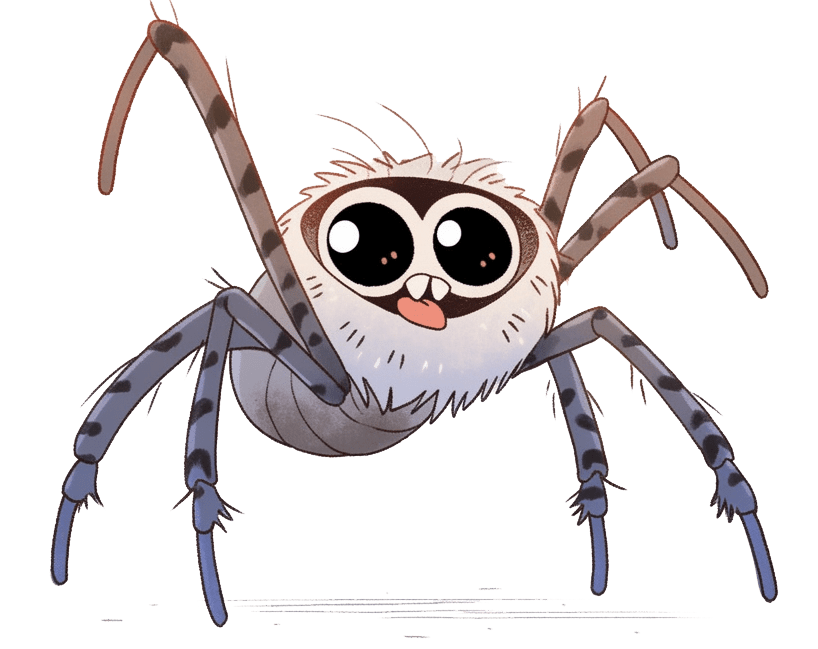
The number one rule for spider care:
Mind your business.
In most contexts, the spider knows what to do and any intervention on your part would do more harm than good.
Adoptions
Research the breeder where you intend to get your spiders; ask them where they get their spiders from and how old it is. If it was wild-caught it’s probably already gravid (pregnant) and you’ll be a spider mom to many very soon.
What you need:
- Small paint brush (if you ever need to move your spider or separate slings [baby spiderlings], these are a soft, safe way to move them without hurting them)
- A fine mister bottle
- Enclosure with some air holes. Not because they need a lot of air, but because it needs to stay humid inside, and it’ll be gross if there’s no airflow. Here and here are good places to look.
What you want:
- LED light
- Tweezers for handling their food
- Soldering iron to make quick holes in a makeshift enclosure
- mesh for covering ventilation holes if they’re super small
- enclosure decor: silk flowers, sticks, pet store moss
- magnets for mounting enclosure decor
- Hot glue gun (for gluing to magnets)
- macro lens to take cute pictures of them.
- sharpies (to label enclosures)
FEEDING
How often?
- i2 → 2-3 melanogaster flies per day
- i3 → you can start giving them hydei flies
- sub-adult → 3-7 days
- adult → 5-9 days
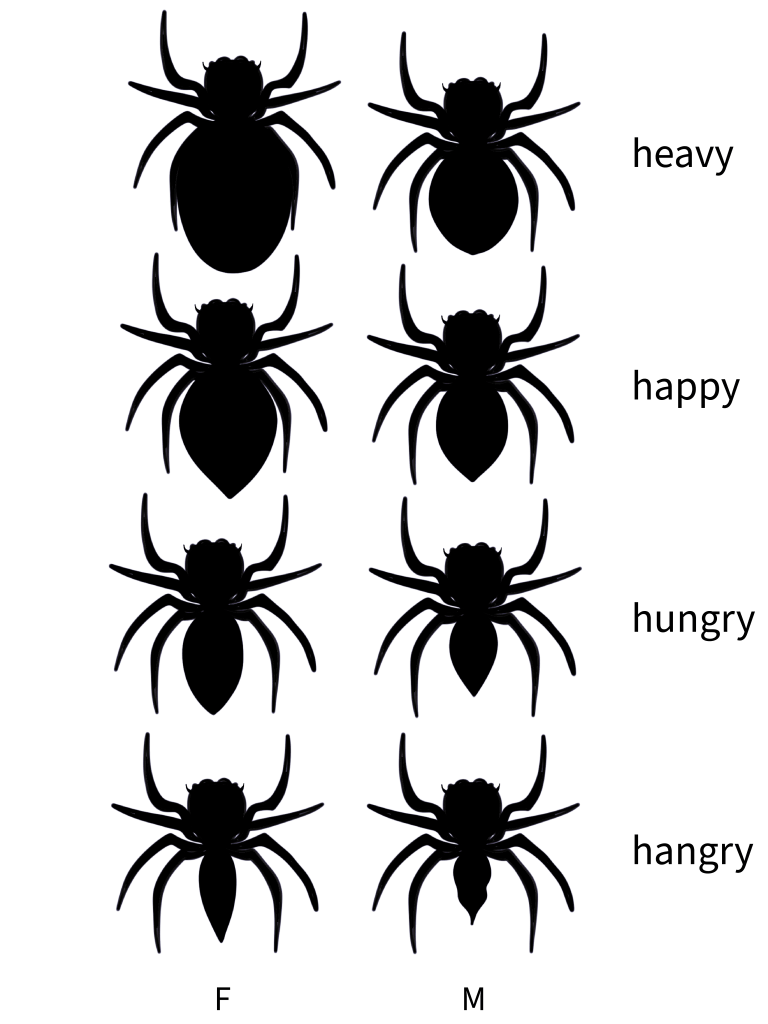
The best gauge is their abdomen
if they’re nice and plump, give it a few days. They can be overfed, evident by an exceptionally large abdomen. It’s not ideal to overfeed them because it might cause them to fall and rupture their abdomen, but it’s usually fine — mind your business wait to feed them again until the abdomen is at the ‘hungry’ size.
Note: When they eat, they grab their prey and feed for hours. Try not to disturb them and definitely don’t take their food away. Be wary of hand feeding with tongs; they might just hang out on the tongs while they eat and then make you feel bad when you have to try and move them so you can take your tongs back.
Mature male spiders eat less than mature females and can go weeks without eating. Unless they become sluggish and suspiciously small, mind your business.
What to feed them:
Or rather, what shouldn’t you feed them? Ants! They produce formic acid that can harm your spider.
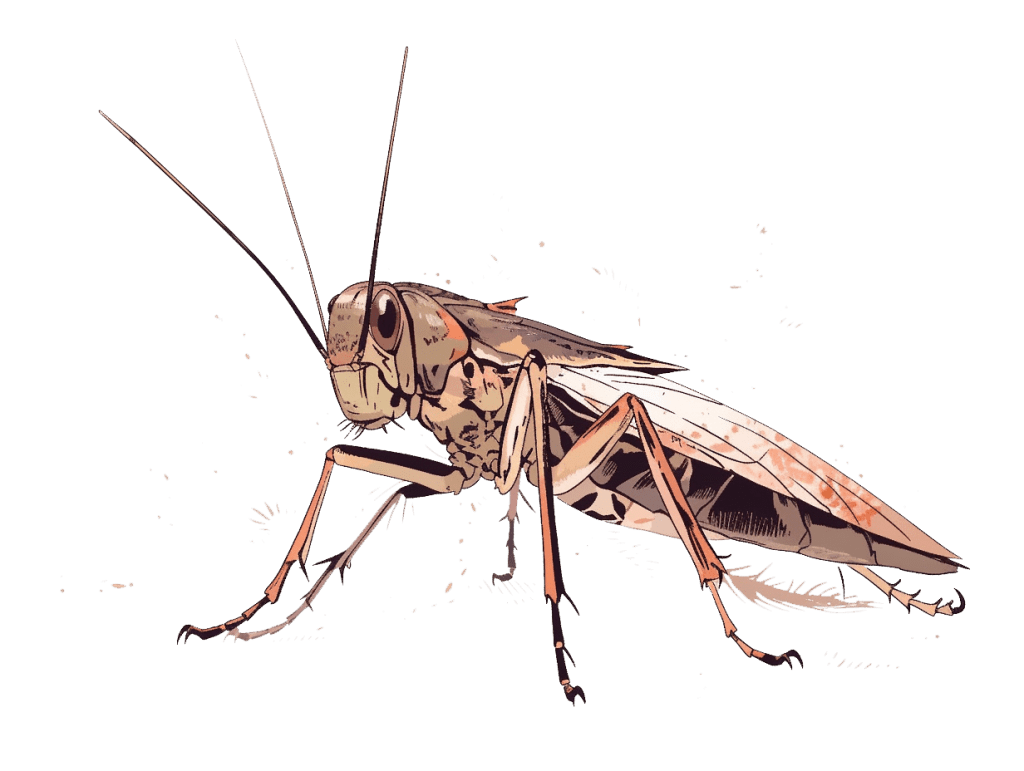
Virtually all the other feeder insects are good options: fruit/house flies and pupae, crickets, mealworms, super-worms, dubia roaches, etc.
Crickets are dicey because they fight back and it’s not unheard of for the cricket to kill the spider, but it is very rare — your spider is super tough. Crickets can climb, so keep them away from a molting spider.
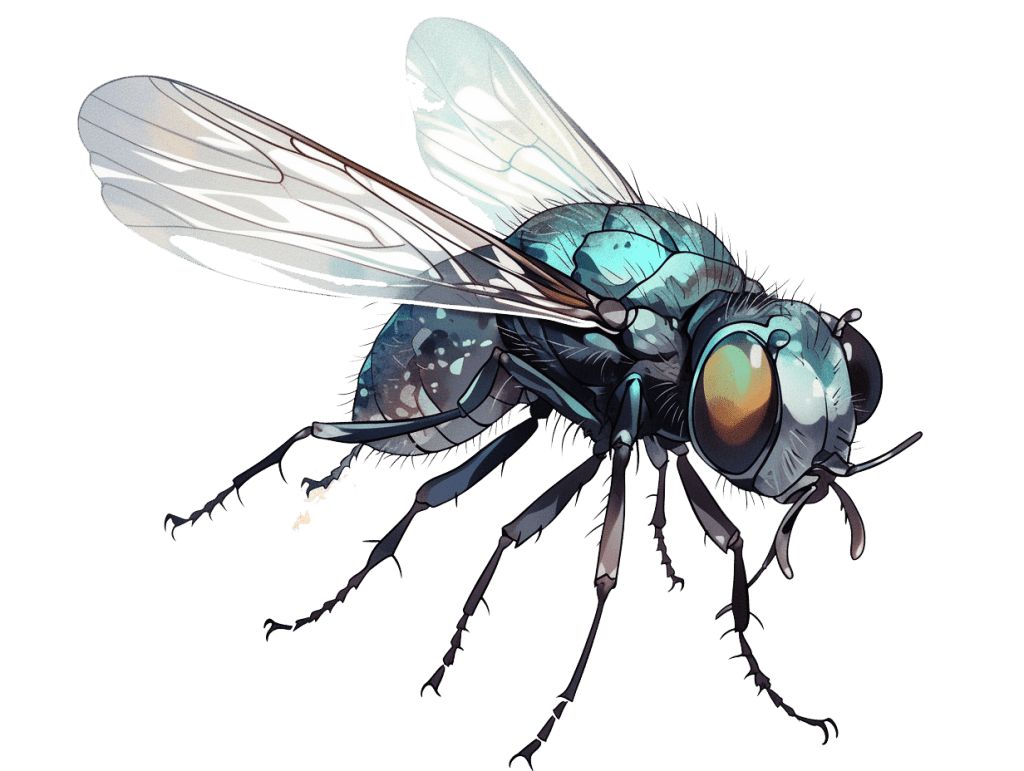
Larger flies are arguably the preferred option because they pose no threat and your spider likes the hunt.
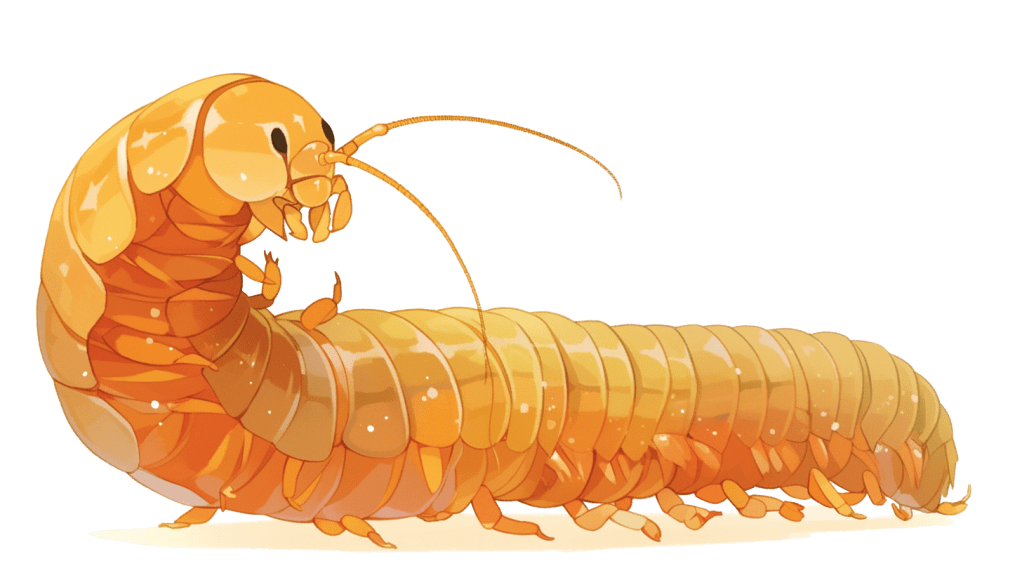
The various kinds of worms and dubia roaches are sneaky hiders and they’ll burrow instantly given the chance, so if you have a bioactive enclosure make sure to either put them in a dish or hand feed with tongs
Note: It’s ill advised to feed your spider anything wild caught. You don’t know where it’s been or what it’s been exposed to.
What if they’re not eating?
Mind your business. The spider will eat when it’s hungry. That being said, some spiders are picky eaters and prefer one prey over another. If they’re not moving slower than usual, leave them be and try again later. If they are being sluggish and you’re confident that it’s not pre-molt behavior, you can try some spider-ER maneuvers (below).
WATER
The most commonly kept jumping spiders are tropical species, and they like it humid. They get most of their hydration from their food, but they need humidity to molt properly and being comfortable. The ideal enclosure will be one resembling their natural habitat — a bioactive enclosure with live plants. It doesn’t have to be an elaborate self-balancing ecosystem; a small tropical house plant and the appropriate substrate is all you need. The moist soil will keep the rest of the enclosure comfortably humid. You can keep a hygrometer in the enclosure, they’re small and cheap and helps to make sure everything is in order, but it’s not necessary.
If you decide against bioactive, the humidity has to be supplied either by misting, or leaving a wet cotton-ball in the enclosure. Change the cotton-ball often to prevent it getting gross. If you want to mist, get a very fine mister and spray your walls, not your spider. Any standing water or large droplets could drown your spider.
Try not to go below 50% humidity as a baseline, and keep it closer to 75% for tropical species (like phidippus regius).
TEMPERATURE
For the most part, you can follow the rule of ‘if you’re comfortable, they’re comfortable’. Try to keep the temperature in their enclosure between 70-80°F. If you need external heat sources, be careful not to get it too hot. Traditional reptile heaters and lamps will provide too much heat and potentially melt your enclosure. Bright LEDs put off a very mild heat, so that can be a good option for supplemental heat.
LIGHT
Jumping spiders have those big cute eyes, and those big cute eyes need light to hunt. Ideally, get them set up with a bright LED on a timer. They’ll do fine with indirect ambient light, but avoid leaving them in a place where they’ll be in direct sunlight.
ENCLOSURE
ENCLOSURE
Jumping Spiders are cannibalistic – do not house them together because only one will prevail. The only exception is a mother and her new babies.
New enclosures are stressful
When first moved into a new enclosure, the spider may have trouble gripping the wall. Over the first day or so, the spider will spread some webbing around the walls to make it easier to get around. They’ll be stressed for a few days while they settle in and spread their webbing around. Leave them alone, don’t stress, mind your business while they get their bearings.
Within a day or so, your spider will make a hammock to hang out in. The hammocks are usually in a top corner (occasionally on the bottom), so it’s vital to keep them in an enclosure that doesn’t open from the top. Eventually they might build a few hammocks around the enclosure and they’ll switch back and forth. Don’t remove them, don’t clean them, don’t touch them.
If you accidentally tear or ruin their hammock, apologize immediately. Then forgive yourself and try not to do it again.
They love their hammocks. Most of their time will be spent in their hammock. Don’t be salty about it.
MOLTING
Molting is like a spider birthday! They’ll most likely spin up an extra thick hammock and stay in for a few days. You’re not invited to their birthday party — let them celebrate in peace and they’ll come out when they’re ready. Make sure to monitor the humidity extra carefully during a molt; low humidity during molting can can be fatal.
Their molts/birthdays are referred to as their ‘instar’. At birth, they’re instar 1 or ‘i1’. Over the course of their lives, they’ll molt around 10 times spread out over 6-12 months. The time in between molts depends on how much they eat. If they stay consistently full, they’ll grow more quickly and molt more often, subsequently reaching maturity more quickly…and overall leading a shorter life. Keep this is in mind when feeding them.
Molts can be fast or slow. Typically, younger spiders molt faster (~1 hour) and older spiders can take weeks. As always, mind your business and don’t interrupt their birthday. Although the molting process might be quick, your spood will probably stay in their hammock for a while after the molt to adjust and firm up.
A cool thing: if your sub-adult spider suffers a lost limb or another injury, they might emerge from their next molt with a fresh new limb. Miracle!
You can offer food, as long as it isn’t anything that might invade their hammock. They probably won’t eat until they’re totally ready to come out.
Every once in a while, a spider will molt outside their hammock. It’s unusual, but not unheard of. Don’t intervene, or try to move them.
If they look stuck, still don’t intervene. Look up some pictures and videos of spiders being stuck, so you know what to look for. Give them plenty of time and make sure the humidity is high. Only intervene if you’re pretty sure they’ll die without your help, because your intervention might be fatal.
As far as I know, the only thing you can do to help is try to make it easy for them. Very gently move them onto a moist paper towel and use a small paintbrush to ultra gently help them out of their exoskeleton. You can try to offer them a q-tip with some sugar water to give them a boost. Remember that their post-molt body is soft and vulnerable, so they’re extremely sensitive to touch.
If they look stuck mid-molt…
Still don’t intervene. Look up some pictures and videos of spiders being stuck, so you know what to look for. Give them plenty of time and make sure the humidity is high. Only intervene if you’re pretty sure they’ll die without your help, because your intervention might be fatal.
As far as I know, the only thing you can do to help is try to make it easy for them. Very gently move them onto a moist paper towel and use a small paintbrush to ultra gently help them out of their exoskeleton. You can try to offer them a q-tip with some sugar water to give them a boost. Remember that their post-molt body is soft and vulnerable, so they’re extremely sensitive to touch.
Sometimes there’s nothing to be done and you have to make a judgement call.
A note about lifespan
A jumping spider’s life is dictated by their metabolism. Their metabolism is dictated by activity level, and their activity level is dictated by temperature.
If you feed your spider more often, it will molt more often, and it will live less time.
If you don’t provide a supplemental heat source, the spiders will slow down when it’s cold (<75°F). They’ll need to eat less often and they won’t be as active, which means fewer molts, and a longer life.
As their spider mom, you can spoil them rotten–keep them warm and fat and happy, but it will mean a shorter life.
If you wait to feed them until they’re hungry again, and let the temperatures fluctuate with the seasons, your spider will live a longer life.
If they’re acting weird and you’re worried:
If your spider is being extra slow, or sitting in an unusual place and not moving, these are the things to check for:
- Dehydration: make sure the humidity is at a reasonable level
- if you’re worried it might be dehydration, tear off a small corner of a paper towel, wet it, and place it near them. It’ll give them a place to rest and hydrate without fear of drowning.
- Temperature.
- if the temperature is lower than 75°C, try to offer some gentle heat, but be careful not to overdo it: ex. move their enclosure under a lamp that gives off gentle heat.
If they’re still not perking up, you can try to coax them onto a paper towel wet with sugar water, and let them sit in a warm, humid place until they become more active before moving them back into their regular enclosure.
 hovel
hovel 